Three Tenants Reclaim £16,224 From An Unlicensed HMO
Introduction
In a recent Rent Repayment Order decision, three tenants from Flat 8, Trinity House in Southwark took their landlord to the First-tier Tribunal. Their claim? That their landlord had failed to obtain the correct HMO licence while they were living there. What followed was a year-long legal process ending in a significant financial penalty.
What Happened
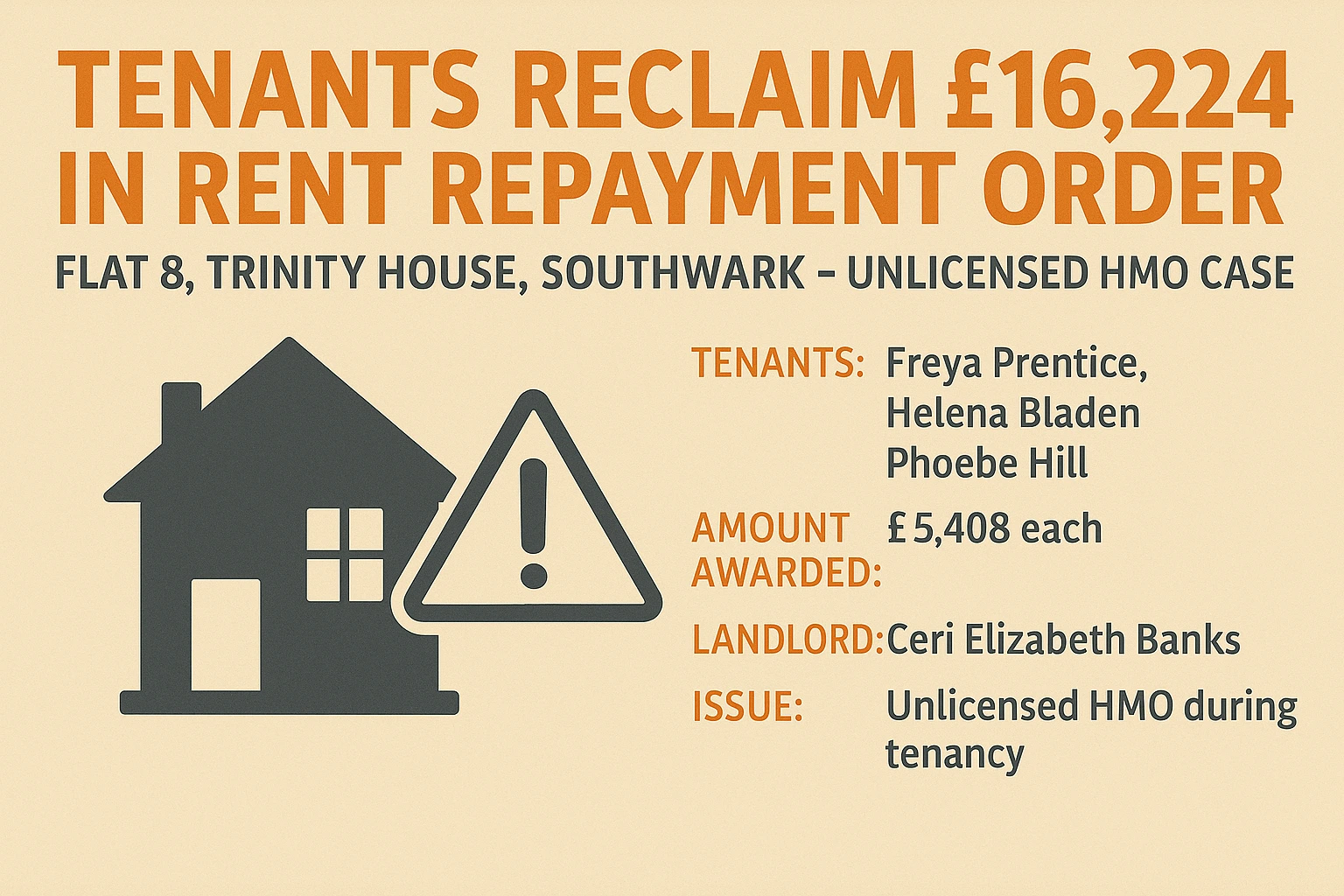
Freya Prentice, Helena Bladen, and Phoebe Hill rented a 3-bedroom ground floor flat at Trinity House in London SE1 between July 2022 and July 2023. During this period, the flat was a licensable HMO under Southwark Council’s Additional Licensing Scheme. However, the landlord, Ceri Elizabeth Banks, did not obtain the necessary licence until after the tenancy had ended—applying only in August 2023 and receiving it a month later.
The tenants, supported by Justice for Tenants, applied for a Rent Repayment Order in July 2024. The landlord failed to fully engage with the proceedings, missing deadlines and eventually being barred from further participation.
What Did the Tribunal Find?
The Tribunal confirmed that the landlord had committed an offence under section 72(1) of the Housing Act 2004 by managing an unlicensed HMO. The application for a licence came too late to cover the tenancy period. As a result, the Tribunal determined that a Rent Repayment Order was appropriate.
Although the maximum claim was £24,960 (the full rent paid), the Tribunal awarded a lower sum of £16,224. The decision doesn’t detail the precise mitigation factors, but reductions are commonly based on issues such as lack of intent, later compliance, or tenant benefit from the property.
What Was the Final Decision?
-
Total Rent Repayment Ordered: £16,224
-
Split Evenly Between Tenants:
-
£5,408 each to Freya Prentice, Helena Bladen, and Phoebe Hill
-
-
The landlord was also ordered to repay the Tribunal fees within 28 days.
What Can Landlords and Tenants Learn from This?
Landlords should treat licensing requirements with utmost seriousness. Applying for a licence after a tenancy ends does not retroactively cover their legal obligations. Failing to comply opens them up to costly enforcement action and RROs.
Tenants living in shared housing should check whether their home is licensed. Councils often list this publicly. If you discover a property is unlicensed, legal aid organisations like Justice for Tenants can help you claim back rent through the tribunal.
Final Thoughts
This case is another reminder that RROs are a powerful tool for renters and a serious financial risk for non-compliant landlords. Even without active landlord participation, the Tribunal will proceed and uphold tenants’ rights. If you’re unsure about your housing situation, it pays to get informed early—before a full year’s rent goes unpaid by the law.
Could this apply to you?
Nearly every case in this series turns on the same thing: a property that needed a licence and did not have one. That is not rare, and it is free to check.
- Look up the address on your council's public licensing register. Mandatory HMO licensing covers five or more people from two or more households, and many councils run additional or selective schemes covering ordinary lets too. How to check a landlord and property.
- Work out whether your home is an HMO and what that means for your rights. Your rights in a shared house.
- See what a claim involves, including the time limits. A Rent Repayment Order can return up to twelve months' rent, and you can apply after you have moved out. Claiming money back from your landlord.
- Read the wider pattern in our analysis of thousands of tribunal decisions. What Rent Repayment Order data says.
And whatever the outcome, review the landlord and the property. A tribunal decision helps the tenants who brought it. A review reaches the person about to sign next.